
Nicholas Karlovich Nicholas Karlovich

One to five

2012 spec: "Balances the current science of astrophysics with enjoyable interactivity."

On page 26 of the 2012 spec, under the heading INTERACTIONS, I wrote the rule that decided what happened when two stars collided.

For the purposes of the prototype, this is simple math. Add up the masses. Mass of 5 or more = Black hole.

Star masses in that document ran one to five. Not solar masses. Just one, two, three, four, five. NIK was a one. There were five stars, each with a name and a simple, beautiful vector animation sequence, and between them they covered everything a star could be.

Page three of the same document says the game "balances the current science of astrophysics with enjoyable interactivity."

Compromises

Starlife was the first game I was attempting to build, and I knew this was a risk. Every rule had to fit in my head. Every object, every interaction. I wanted players to grasp the gameplay intuitively, so it needed to be simple. I didn’t even plan a tutorial level to explain it. I didn’t feel the spec was finished in 2012, since I knew that would require iteration and testing. Games are all about the feel, multitouch mobile games even more so. But the plan was to execute it as written, since every question I could think of was already answered in the doc.

The first compromise was development. I knew I could not code. That one was easy to plan around, and in the end it was the one that killed the project, though not for technical reasons. It was my personal project, I did not know how to build it, and I did not know how to work with someone else on it either. But that compromise was good planning back then. It kept the scope realistic for a small team to build. Everything was clear. No technical limitations or questions loomed.

The second compromise was a creative one, a style choice. "Mass of five or more" was game design, a game rule. It’s only become clear to me now, in discussing this game with others, that this constraint existed. I made the rules up based on what I thought would be fun. That’s what the creative director does, right? I have since discovered a better way, but it would not have been possible in 2012. After all, I’m not a scientist.

Unknown unknowns

In 2026 the development problem went away, which I have written about already. Well, “went away” is understating the work required to learn AI tools, what setup is best for the job, and refining instructions, memory, all that. I did those things, and what I expected was that the spec would now get built.

It was, at first. You can watch it happen in the mass numbers.

My original spec gave every star a mass from one to five. The build started somewhere else, at 2, 4, 8, 16, 32, then compressed on 23 April to one, two, three, four, five, and on the 24th to a range of 0.5 to 5. I was trying to land on the right curve for the rules, going back and forth testing things.

On the 26th I hit a problem. Stars needed a mass for gravity and a mass for the progress bar, and one value could not do both jobs. So I added a second one. ADR-008 records it without comment: gravitational mass kept separate, new scoreMass field added. Every star now carried two masses and the document carried a table to reconcile them.

ADR-008 closed out on 29 April. On the 30th the catalogue switched to real solar masses, 0.3 to 25, and scoreMass was deleted. One number now covered gravity and scoring, because a real mass already means both of those things. starGravityK was halved the same day so the orbits kept their feel.

The invented numbers needed scaffolding to work. The real ones did not, and the scaffolding came out. Getting more accurate made the game simpler, which is not what I expected accuracy to do.

So what was that second compromise? It was the research. It was the ability to actually find, understand, and implement the real physics into the game rules. 2012 me never even tried, so the rules were a creative exercise. I couldn’t know how much that would cost, the depth I would lose from simply never considering some realism. Astrophysics is a hard science based on math. Some mathematically inclined readers may scoff at this, but the truth is, it was impossible for ME.

On May 21st, 2026 a commit message ends with two words: "science pass." Reference stars arrive. Real spectral classes arrive. By July it had a name. I told Claude, mid-argument about an accretion disc that would not sit right, that the thing I always do in this situation is ask “what does the science say?” We wrote it into the project instructions that afternoon.

Science rules

Starlife was inspired by a multitouch puzzle game called Eliss by Steph Thirion. That game was a masterpiece. I did not set out to make something educational. In fact I still loathe those kind of games. However, every time the scope changed, it was because the science provided an answer to a design question that was more interesting than the thing I had planned. It turns out the physics is the fun part, as long as it drives the mechanics instead of decorating them.

The gap in my understanding appeared as a design decision, but it wasn’t. Starlife still makes plenty of compromises with reality. Distances are impossible. Time is totally weird. But now when I have to compromise I understand more about why than I did before. The creative challenge on this project is negotiating these compromises, not coming up with ‘fun’ rules. The fun, as Claude likes to say, “falls out for free.”

Much of the spec survives. The gather gesture on page 22, holding a finger in the gas until it collapses, is the gesture in the game. All of the gas interactivity is unchanged. The mass bar on page 19, filling in creation order, is almost exactly the same, just horizontal now. Even many of the colors are still in the palette, unchanged, fourteen years later.

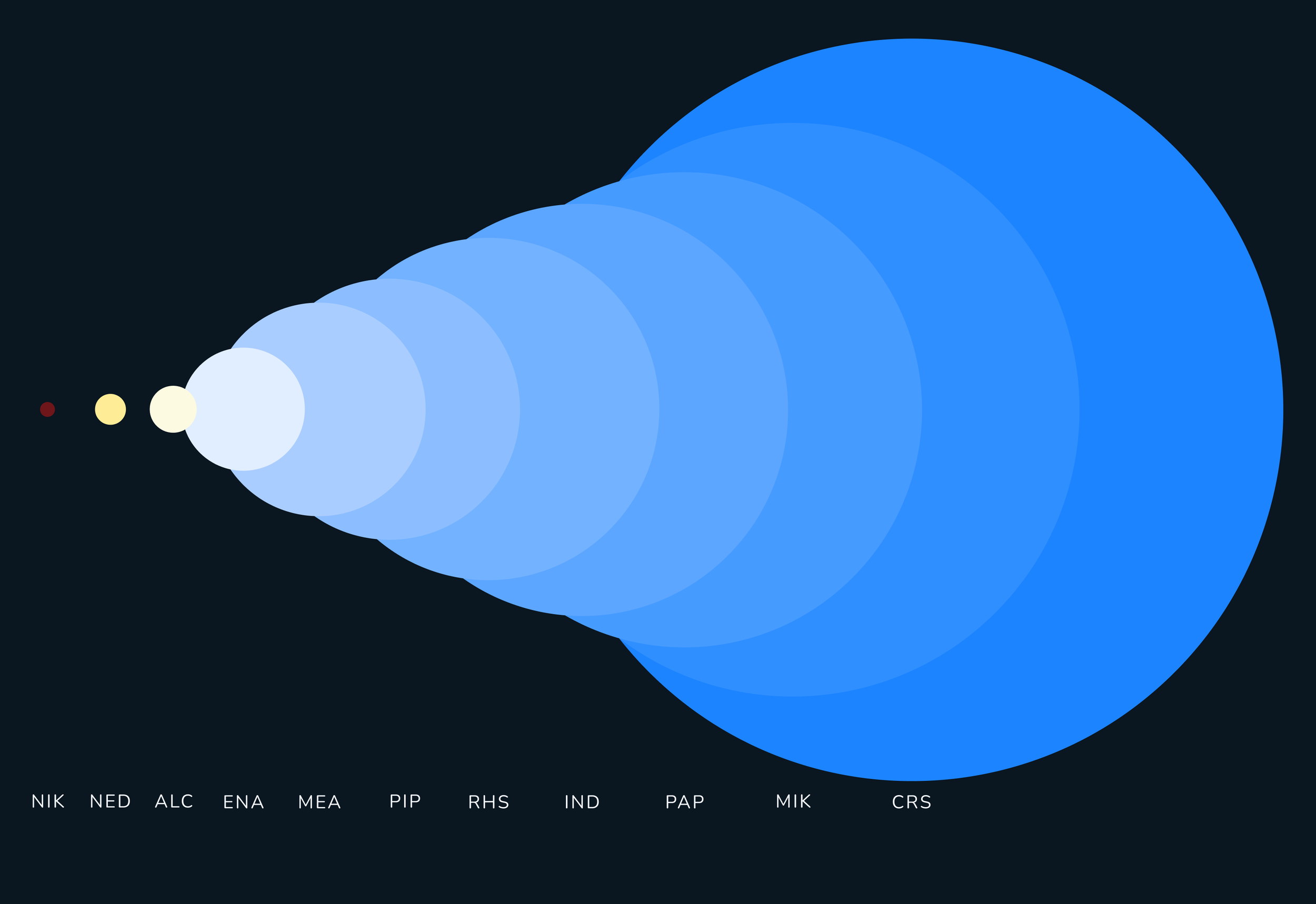
The Starlife mass ladder in 2026.

The visual design was fine. The science was non-existent. In 2026 five stars became eleven mass windows running from 0.3 to 200 solar masses, each one modeled on a real star, each one dying the way its mass says it has to. None of that was in the spec. All of it came from asking one question and letting the answer change the plan.

Starlife is coming to iPhone and iPad. If you want to follow along and get into the TestFlight beta, sign up at starlife.info.

Read More

Starlife Devlog

Welcome to the making of Starlife, a scientifically accurate astrophysics puzzle for iPad and iPhone, built solo. One post a month on the science, the code, and the design behind the game. A star’s life at your fingertips, and the occasional story of asking what the physics actually does, then letting it win.