
I hope that my players will come to appreciate the fact that Starlife is designed around real astrophysics. I have mentioned the benefits of this approach in a previous post, so this post is about the detriments. The astrophysics literature is mostly open, and I have taken great joy in translating the rules of the universe into a game. The basics build a wonderful model. But there are gaps. There are things we don’t know about the life of stars. Some scientists may quibble with my negative framing (detriments) since these unanswered questions (literal astrophysics puzzles) are their raison d’être. No doubt these blissful experts are furiously working to formulate answers. Some of them might even be willing to help (please read on!).
The core conceit of Starlife is compressing the deep time of the universe into moments where entire stellar phenomena can be witnessed from beginning to end. Much to my chagrin, we don’t understand how everything works in the universe. A game is a closed, deterministic system with rules, through which players explore all outcomes. This forces me to answer questions the universe has given too little evidence to answer. Well, that’s the good case. The bad case is just where I’ve made mistakes. Feedback is welcome in both cases.
Filling the gaps
Here are three typical examples. We made something up, did research after it felt off, and found thinner-than-expected answers.
For most of the development so far, NIK, the 0.3-solar-mass red dwarf at the bottom of the ladder, did not die at all. It had no life arc. The game looked up a star’s life arc from its nearest catalog entry, and NIK had none, so every star under one solar mass was immortal. A 0.99-solar-mass star lived forever, and a 1.00 lived four minutes. It was a bug, and fixing it was a question for the science. A star that small burns for hundreds of billions of years, and the universe is only 13.8 billion years old. The theory we used is a model by Adams and Laughlin (1997). A NIK now ends as a helium white dwarf after it lives 494 seconds, which matches the mass/lifetime curve we use for all the other stars in the game. Now we wait a few hundred billion years to definitively confirm the theory.
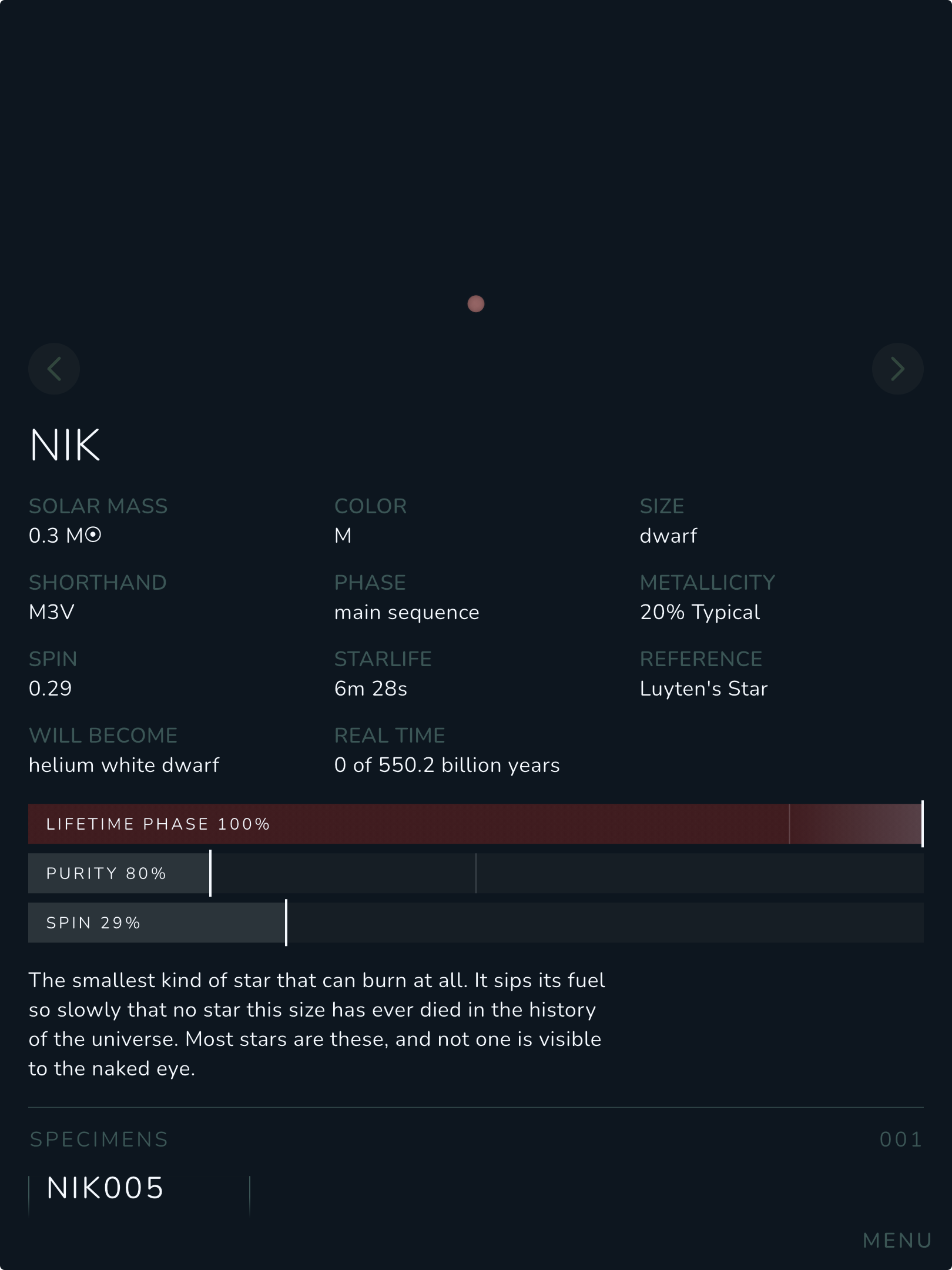
NIK’s Codex entry, updated WILL BECOME field, “helium white dwarf”
When creating a star from gas in Starlife, you can add spin by winding your finger around the center of the protostar. A spun star lives longer, because rotation stirs fresh fuel into the core. The first version of that bonus was 50 percent, a number picked to make winding feel worth doing. Then we read the Geneva models (Ekström and colleagues, 2012): 20 to 28 percent for a typical fast rotator, 30 to 35 for the fastest. The bonus became 35. Two weeks later we downloaded a second family of models (Choi and colleagues, 2016) for a different reason, and at the same rotation they gave 1 to 7 percent for stars from 2 to 75 solar masses. Two respected model families with very different results. The disagreement will end when someone measures a star’s whole life from beginning to end. The bonus is 20 percent now, between the two.
When a neutron star grows past some mass limit, it collapses into a black hole. In Starlife that limit was 3.0 solar masses for four months, a round number chosen during an early rebalance because it was round (game design at its finest). The real limit depends on how matter behaves when you compress the mass of the sun into a 20 km diameter ball, so it has never been measured directly. In 2017 two neutron stars were seen merging, and the event bracketed the limit near 2.2 to 2.3 solar masses (Margalit and Metzger 2017, and Rezzolla, Most and Weih 2018). The heaviest well-measured pulsars sit near 2.1. The game’s limit is 2.3 now, so a neutron star that feeds on gas becomes a black hole after eating about 0.9 solar masses. Breath is bated for the next neutron star merger to provide more evidence.
The list
When the science has an answer, the game gets better. When it doesn’t, I still have to provide a number. So, as a responsible game design nerd, I created Where the Science Stops, and on its first day it had 26 entries. Each one records what is known, where the knowledge ends, what the game does, and who might know more.
A few more fun examples:
A large living star that swallows a neutron star was predicted in 1975 (Thorne and Żytkow). None has been confirmed. In Starlife you can make one, so I had to decide its behaviors.
One red supergiant has been seen to vanish without a supernova, a star called N6946-BH1. The game has a whole way of dying built on it. Technically this is called a “failed supernova” because it’s assumed most of the mass simply collapses into a black hole instead of the usual fireworks. The mechanism is not confirmed.
Betelgeuse threw off a piece of its surface in 2019 and dimmed for months. One other star has been caught doing the same. Two events are not enough for the accuracy-obsessed game designer to pin down the rate at which this phenomenon occurs.
An invitation
I’ll be posting some of these open questions on the social channels for the next few months. I’m also going to publish the list on the starlife.info landing page. If you work on this kind of stuff, consider this an open invitation to respond. Reply where you read it or, better yet, write to hello@starlife.info with SCIENCE in the subject line. The game is still in development, but the demo is on itch.io, so I’d love to have feedback on what’s built so far.
If you improve the game’s accuracy with plausible theories, you get a line in the game’s credits with your name and the topic.
The questions so far
Here are the questions from the list that are ready to ask in public, sorted by why they are still open. The full list, with what is known and where the knowledge ends, will go on the starlife.info landing page.
Where the models disagree
How much longer does a spinning star live?
Do metal-poor massive stars end their lives as red or yellow giants, or do they stay blue?
What is the lightest single star that becomes a Wolf-Rayet (a hot star that has blown off its outer layers)?
How much mass does a massive star lose to its wind?
Does every very massive star go through an unstable, flaring phase (a luminous blue variable), and for how long?
Does a star made by two stars merging come out magnetic?
What sets off a Type Ia supernova, the exploding white dwarf astronomers use to measure distances across the universe?
Where does the universe’s gold come from?
Predicted, never seen
How does a red dwarf end?
Do Thorne-Żytkow objects (a large star with a neutron star at its heart) exist, what do they look like, and how do they end?
What does a star look like just before it blows itself completely apart in a pair-instability supernova?
Seen too few times
How heavy can a neutron star get?
Which stars collapse quietly into a black hole with no supernova?
Has anyone ever seen a pair-instability supernova, and which stars make one?
Seen, but nobody knows how often
How often does a red supergiant throw off a piece of its surface?
purposeful departures
Here are the places we knowingly bend the science, because it’s a game. You may quibble with my choices here, but these are established to make the game playable and fun.
Time. As much as I’d love to spend a billion years playing with stars, there are limits to the human attention span.
Your fingers. Things in nature happen by complex interactions without (evidence of) entities playing God pushing things around and making gravity happen spontaneously.
Distance. Things need to fit on the screen. If everything were spatially accurate, the stars would be invisible points. So they’re drawn far too big for the space between them. Stars in Starlife collide all the time, where in nature they almost never do outside the densest star clusters.
Starlife is coming to iPhone and iPad. If you want to follow along and get into the TestFlight beta, sign up at starlife.info.